Can direct bonds beat fixed income ETFs?
A recent analysis by FIIG Securities (FIIG) shows most bond exchange traded funds (ETFs) underperform their indices or, at best, break even over time.
Moreover, the benchmarks for most ETFs may be considered conservative and may not provide the income most investors are seeking or perhaps expect when choosing bonds in their fixed income allocation (in fact, it is likely many advisers and investors would be unaware of the exposures included in the benchmarks).
In comparison, the analysis found direct bond portfolios regularly outperform the indices while also providing higher annual income as a general rule.
The research showed that, over longer time frames, the direct bond model outperformed all the major indices and the comparator sample of common fixed income ETFs.
Passive ETFs replicate the index, but with an ongoing fee dragging on performance
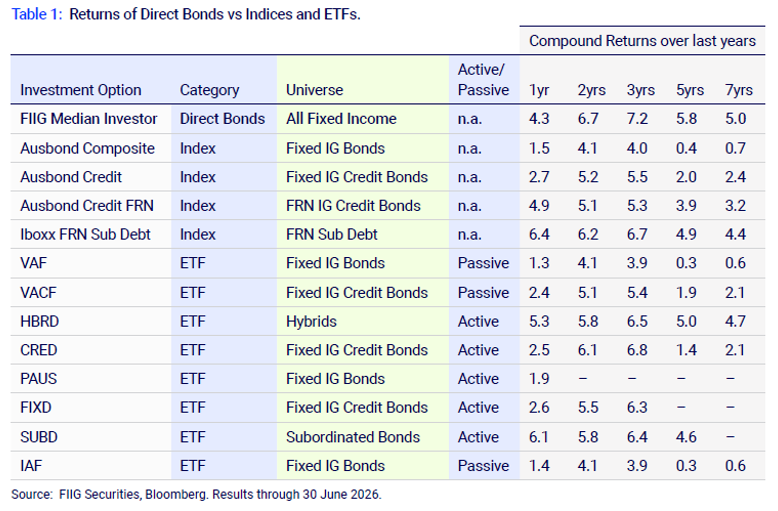
Table 1 shows the results for a FIIG’s median direct bonds client, as well as some important bond indices and major ETFs. The first thing to be aware of is that the returns for the indices themselves (that the ETFs are designed to replicate), are much lower than might be assumed.
Even though the cash rate was between 3.60%-4.35% for 2025-26 the Composite index returned only 1.5% and the Credit index returned only 2.7%. FIIG’s view is this is partly, but not fully, a result of duration risk and rising interest rates.
There is also a more subtle driver which many investors and advisers may not be fully aware of. These indices are market-weighted (by total outstanding) and therefore may be considered conservative because of the preponderance of Government and quasi-Government issuers in the Australian bond market.
The major bank balance sheets and other investors use these highly liquid bonds primarily as a source of liquidity, rather than with the true profit-maximising motive which is generally the case with equities. These bonds focused on providing liquidity are mostly issued by Governments. That makes them lower risk but can also make them too conservative and low-yielding for some income-focused investors.
Direct bond outperformance over time
Unlike ETFs, which mostly have daily price histories, direct bonds are an over the counter (OTC) product which generally don’t have daily results available to the public. However, some providers such as FIIG do publish the results of the Median FIIG client each year and use these yearly results to produce what a pseudo-index of the returns of the Median FIIG client would have been over the last seven years.
The FIIG analysis shows a Median FIIG client’s portfolio has materially outperformed the bond indices, passive ETFs and active ETFs. Furthermore, the returns over time improved, and were not dragged down by fees. In fact, the FIIG median client has outperformed the main Ausbond Composite Index by 36%, cumulatively, over the last 7 years.
Included in this data set are FIIG clients that have a holding of at least five bonds, a minimum portfolio size of AUD$250k and have an Internal Rate of Return calculated the for the portfolio each year.
It should also be noted that FIIG does not aim to outperform an index, but rather achieve the best return for investors overall. As such, the analysis is for illustrative purposes only.
For this analysis, the Ausbond Composite 0+ Index was selected as the most appropriate to benchmark a FIIG client’s portfolio against, as its best reflects the underlying assets held in a client’s portfolio which includes a wide variety of debt. These exposures include, fixed rate, floating rate, long and short duration exposures, high quality investment grade and sub-investment grade also. There are sub-investment grade credit bonds in the FIIG portfolio as well as extremely high-quality short-term Government debt, and everything in between.
More choice, better outcomes
ETFs can be a simple way for advisers to take exposure to the bond market, but the simplicity doesn’t always deliver the strongest returns. Advisers and investors who purchase a bond ETF may find that they are, unintentionally, taking exposures to indices which are very conservative in nature. A direct bond portfolio, in contrast, can prioritise income and returns rather than the extremely high liquidity bank regulators require.
Direct bond portfolios do require relatively more effort and attention in relation to ETF counterparts but the results of this analysis are clear. Bond indices are market-weighted and therefore quite conservative. The ETFs which seek to match these conservative benchmarks are therefore seeking to replicate very conservative positions, which they don’t always manage to do. In contrast, a direct bond portfolio allows investors to prioritise the bonds with a healthier return, rather than the bonds which are primarily designed to be liquidity management tools.
If you would like to learn more about how direct bonds can help clients generate income, please contact AUSIEX Fixed Income.
Important Information
*AUSIEX Fixed Income is provided under the Australian Financial Services Licence of FIIG Securities Limited (FIIG) (ABN 68 085 661 632, AFSL 224659).
Related Articles